


Shopping Cart
Your cart is empty
Add some products to start your order. We ship all over Europe.
"
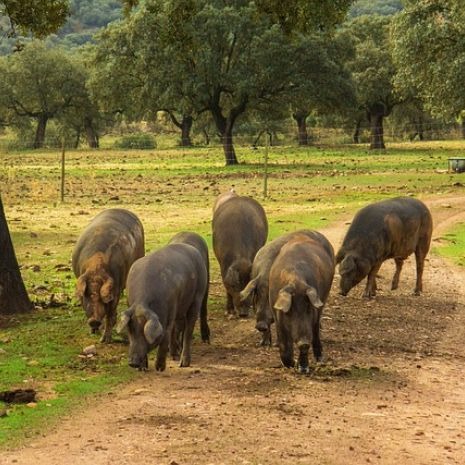
The term “pata negra” originated as a popular way of referring to the highest-quality Iberian ham. Historically, most Iberian pigs have black hooves, while other breeds tend to have lighter hooves. Consumers naturally began to identify fattier hams by the color of their hooves. However, language has evolved, and today “pata negra” has become a colloquial synonym for excellence, not only in ham but also in any gourmet product.
Despite its popularity, official regulations for Iberian ham do not use the term “pata negra” to classify the product. Legislation prefers to use categories based on breed (100% Iberian, 50% Iberian, etc.) and diet (acorn-fed, field-fed, grain-fed). This is important because it means that not all hams with black hooves are Iberian, and not all Iberian hams necessarily have black hooves.
This is where the second great myth comes into play: hoof color. For decades, it was assumed that a black hoof guaranteed that the ham was Iberian and of superior quality. And while it´s true that many Iberian pigs have dark hooves, it´s not a trait exclusive to this breed.
There are crosses and varieties of white pigs that also have dark tones in their hooves. Furthermore, there are 100% Iberian pigs with lighter hooves, which debunks the myth that color is an infallible marker.
The quality of a ham depends on many factors: the animal´s genetics, its diet (acorn-fed, field-fed, or grain-fed), the curing time, and the care of the master ham maker. In fact, one of the most important aspects that is often overlooked is the infiltration of fat into the muscle, which gives it the characteristic white marbling and makes the slice melt in the mouth. This cannot be judged with the naked eye by looking at the hoof.
Therefore, experts currently recommend looking beyond the color and checking the official label that accompanies each piece. These labels are regulated by quality standards and use colors (black, red, green, white) to objectively indicate the type of ham: from 100% acorn-fed Iberian ham to Iberian pig-fed ham. Only then can we know for sure what we are buying.
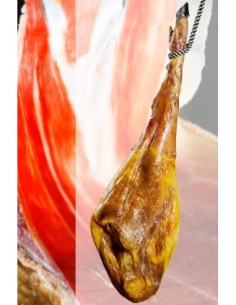 Iberian Ham bellota Guijuelo El Rubio 8 y 9 kg.€393.56
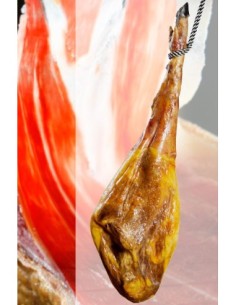 Iberian Ham bellota D.O. Guijuelo El Rubio 8 a 9 kg.€438.45
 Iberian Ham bellota D.O. Guijuelo Gregorio Rodríguez 9 a 9,5 kg€381.70
 Acorn-fed Iberian ham 100% D.O. Guijuelo Hnos. Hoyos 8/9 kg.€469.82
Busting the hoof myth doesn´t mean taking away the charm of Iberian ham. On the contrary, it is an opportunity to highlight the work that goes into each piece. Understanding the true meaning of "pata negra" invites us to better appreciate the history of Iberian pigs, their life in the pasture, the care of the farmers, and the art of the drying sheds. Each slice tells a story that begins long before the product reaches our table.
In a market filled with so many imitations and products of different ranges, consumer education is key to recognizing authentic quality. Simply learning to differentiate acorn-fed ham from a cebo-fed ham, or an Iberian ham from a serrano ham, makes us more conscious buyers and helps us assess the fair price for this delicacy.
Choosing a good ham becomes an experience in itself. It´s not just about buying the most expensive or the one with the darkest hoof, but about finding the one that best suits our taste and budget. There are cebo-fed hams that surprise with their balance, and acorn-fed hams that are true gastronomic gems. The important thing is that the product has traceability, that we know where it comes from and what makes it special.
In the end, true luxury lies in being able to enjoy the product properly, knowing why it tastes the way it does and the effort that went into its production. It´s a small gesture of respect for tradition and the professionals who keep it alive.
At Your Spanish Shop, we share this passion for authenticity and quality. That´s why we´ve carefully selected our hams to offer you only pieces that meet the highest standards, from 100% acorn-fed Iberian ham to value-for-money cebo options.
Because for us, ham is culture, it´s tradition, and it´s a pleasure that deserves to be shared.
Comments (0)