


Shopping Cart
There are no more items in your cart
acorn-fed ham parts
- Your Spanish Shop
- Current Affairs
- 458 likes
- 3493 views
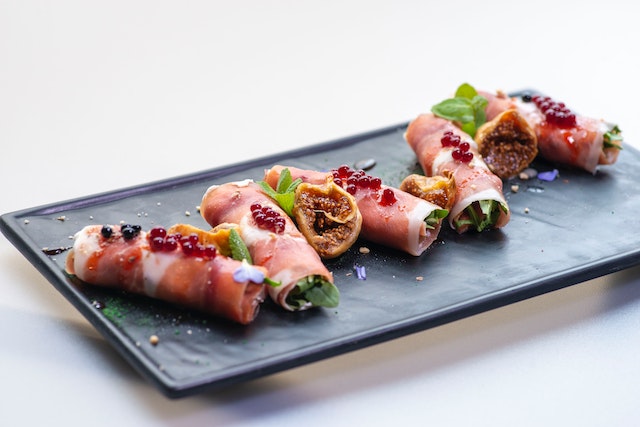
Parts of the acorn-fed ham
Acorn-fed ham is one of the delicacies of Spanish cuisine.
Hams are made from the hind legs of the acorn-fed Iberian pig. From the front part the palettes or shoulder blades are made.
Visit our blog for other news and to review our catalog https://www.yourspanishshop.es/es/comprar-jamon-iberico-espanol/f-112
 Iberian Ham bellota Guijuelo El Rubio 8 y 9 kg.€393.56
 Iberian Ham bellota D.O. Guijuelo El Rubio 8 a 9 kg.€438.45
 Palette of Iberian Bellota D.O.Guijuelo El Rubio 6 kg.€189.95
 Acorn-fed Iberian ham 100% D.O. Guijuelo Hnos. Hoyos 8/9 kg.€469.82
Bellota hamView Bellota ham ›
What are the parts of acorn-fed ham?
The parts of the acorn-fed Iberian ham are fundamental characteristics of this top-quality product. Its parts are cut into thin strips to delight the palate.
Mace. It is considered the most important part of the ham in terms of its consumption. It is the biggest part. It is easily distinguished because it is the widest side that appears when placed with the base of the hoof upwards.
Composed of the biceps femoris, it is semitendinous and semimembranous. It is the part of the Iberian ham leg that contains the largest amounts of meat. It is considered the tastiest part because it is more tender and juicy. It is the easiest to cut. It is an area appreciated for having a higher degree of fat infiltration and offers great performance.
The meat and fat are very balanced in that area of the ham. Her cut is very showy, bright and full of veins. It has an extraordinary smell. Its color is deep red and turns pinkish near the bacon. It is the most tender of the ham areas because the bone speeds up the curing process. The meat of the dough is far from the bone and takes longer to mature.
The slices can be of different sizes when doing it on the sides or central area.
The maza is the area with the most meat, from it you can get 20 dishes. It is the sweetest part of the ham and when pairing it is done with wines with a sweet or floral note.
The contramaza or hip. It is the area opposite the mace. It is narrow and very curated. It has more consistency. Both on the surface and internally it has little fat. It doesn't have much performance. It is very tasty due to the amount of intramuscular fat it contains. The intramuscular bacon from this part has different colors in its cut area.
The difference between the dough and the contramaza is so small that in a tasting it is difficult to differentiate them. Only specialists and professionals know how to distinguish them.
The stifle. It contains less amount of ham than the mace. It is located under the mace. It is bounded by the femur and coxal bones. It is composed of the quadriceps femoris muscles and the tensor fasciae latae. It is less juicy than mace. It is the leanest part.
It has a dark red color. It is the driest and hardest area. It has a saltier taste. They always recommend starting with it when its consumption is going to be prolonged over time. This preserves the piece as well as possible.
When cutting, do not include the yellow parts because they taste rancid. You should take slices with external fat.
It is the least noble part of the ham. It is the most difficult part to cut.
It is recommended to pair the babilla with a wine that causes more salivation.
The tip or butt. It is the distal part of the ham opposite the hoof. It is very tasty and has a good level of fat. The color is pinkish and bright. The pieces are hung by the hooves and the fat slides down each piece, concentrating on the tip. Its meat is tasty and intense, it is cut into small slices. It can be salty if not protected with enough fat.
The cut of the slice must be small to savor the intensity of its aroma and its flavor.
For pairing, we recommend aged wines or a good red wine.
The shank or knuckle: The shank is the part that is next to the tibia and the fibula. It is located between the cane and the mace. It has an intense red tone due to the concentration of nerves and tendons. The texture of that meat is tough and fibrous. It has different flavors. In 100% Iberian acorn-fed hams, it is one of the tastiest parts due to the concentration of oleic acid. It is easy to chew. You can slice or make ham cubes. It can be an accompaniment to different dishes such as salmorejos, scrambled eggs or soups.
At a professional level, cutters tend to slice as one more part. They consider it a highly appreciated morsel of ham for its flavor and texture.
Pairing with aged wines is recommended.
The grey hair. The narrowness of the cane is a sign of purity in the pig breed. It is the area closest to the hoof. It is very oily. It is the narrowest and the one that allows the ham to be identified. If the cane is very thin and stylized, it is Iberian ham. It is used to make ham cubes. It is also highly valued for making broths and stews.
The hoof: It is the part of the leg for the support of the pigs. It is the part that is in contact with the ground. It has a developed nail. Some have the belief that their color marks Iberian pigs, but this is not the case. The Iberian pig can have a black or white hoof. To establish differences check the cane and not the hoof. It is the part where the ham is hung during its curing process. It is used for broths.
Ham bones: It is important to say that the bones are also used in the kitchen to add flavor to the broths. With the bones they are cooked and stewed.
Parts of the acorn-fed Iberian ham
Knowing the parts of the acorn-fed Iberian ham allows you to appreciate its different flavors and its usefulness. To know about Iberian hams is to be part of an ancient tradition. It is to know the Spanish gastronomy from the hand of specialists.
Knowing its parts allows you to recognize an acorn-fed Iberico ham by the narrowness of its cane and not make mistakes.
Each part of the Iberico Bellota Ham has its charm in the smell and flavor that characterizes it.
If you are looking for information about acorn-fed Iberian ham, look for our website https://www.yourspanishshop.es/es/
In our online store we have a catalog and we can advise you to learn more about acorn-fed Iberian ham. https://www.yourspanishshop.es/es/comprar-iberico-spanish-ham/f-112